SAK BRACE

SAK BRACE specializes in medical orthopedic braces, rehabilitation supports, and customized OEM solutions for global distributors, clinics, and healthcare brands.

WhatsApp: 0086-13343185033 / 0086-13132404899 Email: info@sakbrace.com

Pediatric KAFO Brace | Kids Rigid Knee Ankle Foot Orthosis for Leg Paralysis & Alignment

What is this product?

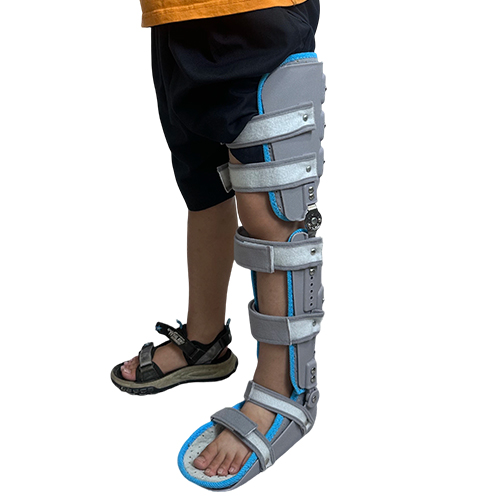
This product is a Pediatric KAFO Brace, widely referred to in global healthcare as a kids’ full leg brace, pediatric knee ankle foot orthosis, or toddler long leg stabilizer. It is a specialized, rigid two-piece lower limb orthopedic apparatus featuring a mechanical knee hinge and an integrated foot piece, used to immobilize, align, and support a child’s entire leg from the thigh to the foot during weight-bearing or walking therapy.

Compliance & Quality Assurance

Every SAK BRACE product is manufactured under strict quality management processes, supporting ISO 13485, CE & EU MDR compliance requirements.

+86-13343185033

info@sakbrace.com

Model
Size
Material
AK-250
S     M     L(Left  Right)
Polypropylene,Aluminium alloy,composite fabric
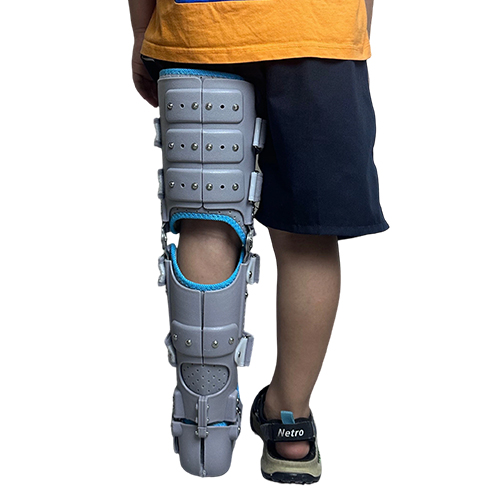
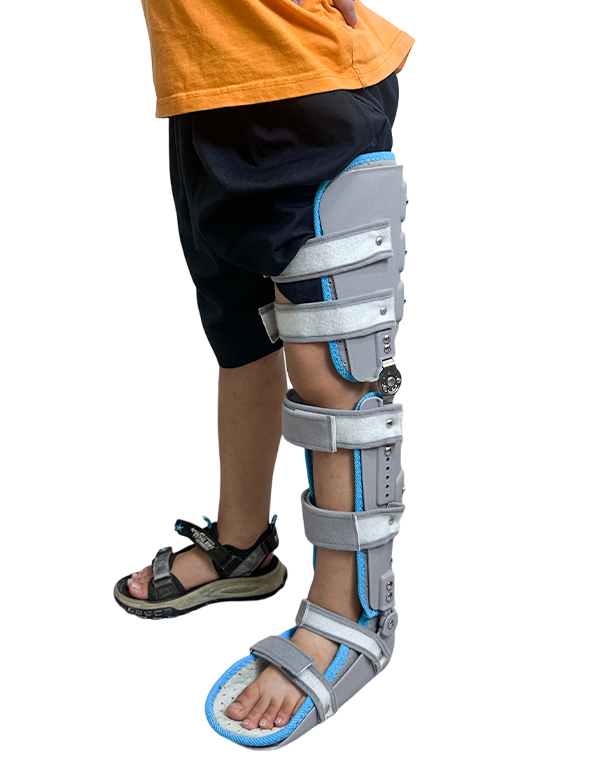
  • The Pediatric KAFO Brace is a medical-grade, rigid lower limb orthosis meticulously engineered to support the unique anatomical needs of growing children. This professional-grade knee ankle foot orthosis integrates high-density, impact-resistant contoured plastic shells with dual-axis metal drop-lock hinges to provide complete structural stability from the upper thigh down to the toes. 
  • Featuring an ultra-comfortable, breathable blue padded liner, it cushions the limb against localized pressure while multiple pre-drilled ventilation ports ensure steady airflow to prevent sweat buildup. Equipped with five adjustable, heavy-duty secure compression straps, this orthosis restricts unwanted joint rotation, controls hyperextension, and maintains precise joint alignment to improve gait and facilitate safer standing or rehabilitation.

Product Introduction

Integrated Full-Leg Orthotic Design

Combines thigh, calf, and foot stabilizing components into a single, comprehensive unit to deliver ultimate mechanical control over the entire lower kinetic chain.

Precision ROM Hinge Mechanism

Features an adjustable Range-of-Motion (ROM) dial that allows clinicians to lock the knee joint at specific angles or set controlled flexion/extension limits during progressive recovery stages.

Rigid Structural Splinting Panels

Engineered with high-strength, lightweight contoured shells that envelope the leg and foot, providing exceptional side-to-side (medial/lateral) stability and preventing axial rotation.

Multi-Strap Circumferential Compression

Utilizes heavy-duty, adjustable hook-and-loop (Velcro) straps positioned strategically across the thigh, lower leg, and foot to ensure custom compression, precise fitting, and anti-slip migration.

Ergonomic Foot and Ankle Guard

Incorporates a protective, rigid footbed shell that maintains the ankle at a neutral $90^\circ$ position while safeguarding the foot from accidental impacts and external forces.

Premium Breathable Padded Liners

Lined with soft, perforated, skin-friendly cushioning that promotes air circulation and limits moisture retention, maintaining excellent patient compliance and hygiene during long-term immobilization.

Suitable for:

  • Pediatric Cerebral Palsy (CP) Patients: Children and young youths dealing with lower limb spasticity, muscle weakness, or unstable gait patterns who require structural knee-ankle alignment.

  • Kids with Polio or Lower Limb Paralysis: Toddlers and children managing pediatric flaccid paralysis, post-polio syndrome, or muscle drop who need a rigid brace to support weight-bearing activities.

  • Young Spina Bifida and Neurological Patients: Children experiencing neurological conditions or congenital spinal cord issues that impair independent lower extremity control and balance.

  • Pediatric Genu Valgum / Varum Corrective Recoverers: Growing children requiring guided mechanical structural stabilization to correct severe knock-knees or bow-legs under orthopedic supervision.

  • Post-Operative Lower Extremity Rehabilitation Patients: Toddlers and youths recovering from major pediatric tendon transfers, osteotomies, or joint contracture release surgeries.

Indications

Knee and Patellar Fractures/Dislocations

Provides rigid external stabilization and joint alignment following fractures of the distal femur, proximal tibia, patella, or acute knee joint dislocations.

Ankle Fractures and Dislocations

Secures stable or surgically fixed fractures of the medial, lateral, or bimalleolar segments, as well as severe talocrural dislocations.

Severe Foot and Ankle Injuries

Ideal for managing high-impact lower extremity trauma, including complex midfoot injuries, tarsal/metatarsal fractures, and severe ligamentous ruptures.

Comprehensive Post-Operative Rehabilitation

Offers complete lower limb immobilization and controlled range-of-motion (ROM) management following joint reconstruction, ligament repair (ACL/PCL/MCL/LCL), osteotomies, or tendon transfers.

People Also Ask

How does the mechanical knee joint function on a pediatric KAFO brace?
  • The pediatric KAFO features a dual-axis metal drop-lock hinge mechanism at the knee section. When the drop-lock ring is slid down, it locks the knee section into a completely straight, rigid extension position ($180^\circ$) to provide maximum stability for standing and weight-bearing. When lifted by a parent or therapist, the lock disengages, allowing the knee joint to flex naturally so the child can sit comfortably in a chair or wheelchair.
  • The lower portion of this KAFO brace is a molded rigid foot plate designed to fit securely underneath the child’s foot. While it can fit into specially designed orthopedic footwear, extra-wide adaptive shoes, or oversized sneakers with removable insoles, it is frequently used in indoor settings or therapy rooms as a standalone stabilizing bootie due to its comprehensive, protective wrap-around bottom profile.
  • To maintain optimal hygiene, the rigid plastic outer frame should be wiped down using a damp microfiber cloth with warm water and a gentle, unscented soap. The breathable blue foam liner can be detached or wiped surface-clean by hand; do not place the brace components in a washing machine or an automatic dryer as intense heat will degrade the hook-and-loop straps and plastic molding. Always let it completely air dry at room temperature before reapplication.
  • To protect sensitive young skin, the child should always wear a long, snug-fitting cotton sock or seamless leggings underneath the entire length of the KAFO brace. Ensure the fabric is completely smoothed out without any wrinkles before securing the five compression straps. Parents must check the child’s leg, ankle bones, and thigh areas daily for any localized red spots, friction marks, or signs of skin irritation.

KAFO (Knee Ankle Foot Orthosis)

Q1. What is a KAFO?
  • A: A Knee Ankle Foot Orthosis (KAFO) is an orthopedic device that stabilizes the knee, ankle, and foot to improve walking ability and lower-limb alignment. It is commonly prescribed for patients with significant knee instability or lower-limb weakness.

  • A: A KAFO may be recommended for patients with post-polio syndrome, stroke, spinal cord injury, muscular weakness, knee instability, or neurological disorders affecting lower-limb function.

  • A: Yes. By providing structural support and improving joint alignment, a KAFO can help patients achieve a safer and more stable gait during rehabilitation.

  • A: KAFOs may be manufactured using lightweight aluminum, stainless steel, carbon fiber composites, thermoplastics, and orthopedic joint components, depending on clinical requirements.

  • A: Yes. We offer OEM and ODM KAFO manufacturing with customized components, branding, packaging, and technical support for orthopedic brands and rehabilitation equipment suppliers.

Get A Quote

Tell us your requirements.Our orthopedic brace specialists will reply within 1-5 hour!

Our team will reply within 1-5 hours!

Related Products

Medical Disclaimer

This product is intended to provide external support only and should not replace professional medical advice. Always consult a healthcare professional for diagnosis and treatment.

Scroll to Top