
Introduction
The anterior cruciate ligament (ACL) is one of the key stabilizing structures within the knee joint and plays an essential role in controlling anterior tibial translation and rotational stability. ACL injuries are among the most common knee injuries, particularly in sports involving sudden stops, pivoting, jumping, and rapid changes of direction.
However, not all ACL injuries are the same. The severity can range from a mild ligament sprain with minimal structural damage to a complete rupture causing significant knee instability. Understanding ACL injury grades helps clinicians evaluate injury severity, define rehabilitation goals, and determine whether additional support, including functional bracing, may be beneficial during recovery.
Clinically, ACL injuries are commonly classified into three grades:
| ACL Injury Grade | Injury Description | Ligament Condition | Knee Stability |
|---|---|---|---|
| Grade 1 | Mild sprain | Ligament fibers stretched with minimal microscopic damage | Stable |
| Grade 2 | Partial tear | Partial disruption of ACL fibers | Mild to moderate instability |
| Grade 3 | Complete rupture | Full ligament tear with loss of functional stability | Significant instability |
This article explains the differences between Grade 1, Grade 2, and Grade 3 ACL injuries, including clinical symptoms, treatment considerations, and the potential role of functional ACL braces during rehabilitation.

1. What Are ACL Injury Grades?
ACL injury grading is a clinical classification system based on the extent of ligament damage and the resulting effect on knee stability.
The grading process considers several factors, including:
- The degree of ligament fiber disruption
- Knee laxity and functional instability
- Patient symptoms and activity limitations
- Physical examination findings
- Imaging results, especially MRI evaluation
Common clinical tests include:
- Lachman test
- Anterior drawer test
- Pivot shift test
MRI is frequently used as an additional diagnostic tool to assess ACL integrity and identify associated injuries such as:
- Meniscus tears
- Bone bruising
- Collateral ligament injuries
- Cartilage damage
Although imaging provides important structural information, treatment decisions are not based solely on MRI findings. Functional stability, patient goals, and activity demands are equally important.
2. Grade 1 ACL Injury: Mild Sprain
Definition
A Grade 1 ACL injury represents the mildest form of ACL damage. The ligament is overstretched but remains structurally intact. Only a small number of microscopic fibers may be affected, and the ACL can still provide normal mechanical stability to the knee.
Unlike higher-grade injuries, Grade 1 ACL sprains usually do not result in significant ligament laxity.
Typical Symptoms
Patients with Grade 1 ACL injuries may experience:
| Symptom | Clinical Presentation |
|---|---|
| Pain | Mild discomfort around the knee |
| Swelling | Usually limited or temporary |
| Stability | Knee remains functionally stable |
| Daily activities | Walking is generally unaffected |
| Sports activity | Discomfort may appear during running, jumping, or sudden movements |
Most patients do not experience a feeling of the knee “giving way.”
Treatment Approach
Conservative management is typically recommended for Grade 1 ACL injuries.
Early treatment may include the PRICE principle:
- Protection
- Rest
- Ice
- Compression
- Elevation
As symptoms improve, rehabilitation focuses on:
- Restoring knee range of motion
- Improving quadriceps and hamstring strength
- Enhancing proprioception and neuromuscular control
- Gradually returning to normal activities
Recovery is generally faster compared with higher-grade injuries, and many patients return to daily activities within several weeks.
Role of ACL Bracing
For most Grade 1 ACL injuries, functional ACL braces are not routinely required because the ligament maintains adequate stability.
However, some patients may choose to use a lightweight knee support during the later stage of rehabilitation or return-to-sport phase to:
- Increase confidence
- Provide additional support during activity
- Reduce psychological hesitation after injury
The decision should always be based on individual patient needs rather than injury grade alone.
3. Grade 2 ACL Injury: Partial ACL Tear
Definition
A Grade 2 ACL injury involves partial disruption of the ligament fibers. Some ACL fibers remain intact, but the ligament becomes elongated and loses part of its normal tension.
Compared with Grade 1 injuries, Grade 2 tears are more likely to affect knee stability, especially during rotational movements or high-demand activities.
Typical Symptoms
| Symptom | Clinical Presentation |
|---|---|
| Pain | Moderate pain, especially during movement |
| Swelling | More noticeable swelling or joint effusion |
| Stability | Mild to moderate instability |
| Movement | Difficulty with pivoting, cutting, or sudden direction changes |
| Functional symptoms | Possible “giving way” episodes |
Patients often report instability during:
- Stair climbing
- Running
- Changing direction
- Sports activities requiring rotation
Treatment Approach
Management of Grade 2 ACL injuries requires individualized assessment.
Conservative Rehabilitation
For patients with acceptable knee stability, rehabilitation may focus on:
- Strengthening surrounding musculature
- Improving dynamic knee control
- Restoring proprioception
- Progressive functional training
A structured rehabilitation program may take approximately 3–4 months, depending on patient progress.
When Surgery May Be Considered
Surgical intervention may be discussed when patients have:
- Persistent instability despite rehabilitation
- High athletic demands
- Participation in pivoting sports
- Associated injuries such as meniscus damage
Treatment decisions should consider:
- Patient age
- Activity level
- Functional requirements
- Knee stability
- Long-term goals
Role of Functional ACL Bracing
Grade 2 ACL injuries represent one of the areas where functional bracing is frequently considered.
A properly designed ACL functional brace may help by:
- Providing external support during movement
- Limiting excessive anterior tibial translation
- Improving confidence during rehabilitation
- Supporting gradual return to activity
However, brace selection should be based on:
- Injury characteristics
- Rehabilitation stage
- Patient activity requirements
A brace should complement rehabilitation rather than replace strength and neuromuscular training.
4. Grade 3 ACL Injury: Complete ACL Rupture
Definition
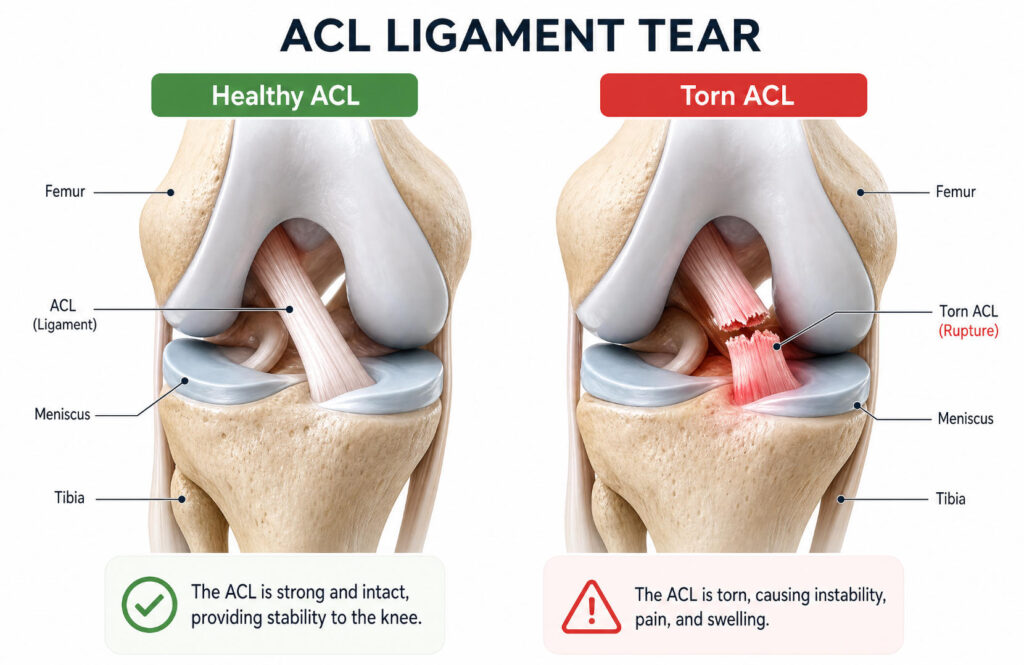
A Grade 3 ACL injury represents a complete rupture of the anterior cruciate ligament. The ligament fibers are fully disrupted, resulting in significant loss of mechanical stability.
The rupture may occur:
- Within the middle portion of the ligament
- Near the femoral attachment
- Near the tibial attachment
Typical Symptoms
| Symptom | Clinical Presentation |
|---|---|
| Injury sensation | Possible “pop” feeling or sound at injury moment |
| Swelling | Rapid and significant swelling due to hemarthrosis |
| Stability | Marked instability and knee giving way |
| Activity limitation | Difficulty with pivoting and high-demand sports |
| Motion | Possible limitation due to pain and swelling |
Many patients experience difficulty trusting the injured knee during daily movement.
Treatment Approach
Treatment for Grade 3 ACL injuries is highly individualized.
Non-Surgical Management
Conservative treatment may be appropriate for:
- Older patients
- Lower activity-demand individuals
- Patients without significant instability
- Those who prefer avoiding surgery
A structured rehabilitation program focuses on:
- Muscle strengthening
- Dynamic stability
- Functional adaptation
ACL Reconstruction Surgery
ACL reconstruction may be considered for patients who:
- Participate in competitive sports
- Experience recurrent instability
- Have combined injuries
- Require high knee function
The goal of ACL reconstruction is to restore knee stability and reduce the risk of secondary damage, including:
- Meniscus injury
- Cartilage degeneration
- Long-term functional limitations
Importantly, not every Grade 3 ACL tear automatically requires surgery. Modern ACL management emphasizes patient-specific decision-making rather than injury grade alone.
5. ACL Injury Grades Comparison: Grade 1 vs Grade 2 vs Grade 3
Although ACL injuries are commonly classified into three grades, the actual clinical situation is more complex than simply matching injury grade with treatment choice. Each grade represents a different level of structural damage and functional impact.
The following table provides a general comparison:
| Comparison Factor | Grade 1 ACL Injury | Grade 2 ACL Injury | Grade 3 ACL Injury |
|---|---|---|---|
| Ligament Damage | Mild stretching or microscopic fiber damage | Partial tearing of ACL fibers | Complete rupture of ACL |
| Structural Integrity | Mostly preserved | Partially compromised | Completely disrupted |
| Knee Stability | Stable | Mild to moderate instability | Significant instability |
| Swelling | Usually mild | Moderate swelling possible | Often rapid and significant swelling |
| Functional Symptoms | Mild discomfort during activity | Possible giving-way episodes | Frequent instability during movement |
| Impact on Sports | Usually temporary limitation | Difficulty with pivoting sports | Often unable to perform high-demand sports |
| Conservative Treatment | Usually effective | Depends on stability and activity level | Possible in selected patients |
| Surgical Consideration | Rarely required | Case-dependent | More commonly considered |
| ACL Brace Consideration | Usually optional | Frequently considered during rehabilitation | May be used after surgery or during non-operative management |
6. How ACL Injury Grade Influences Treatment Decisions
ACL injury grading provides important clinical information, but it should not be the only factor guiding treatment decisions.
Modern ACL management focuses on a patient-centered approach, considering multiple factors beyond ligament damage alone.
Key Factors Affecting Treatment Selection
1. Patient Activity Level
The expected functional demand of the patient plays a major role.
For example:
- A competitive athlete participating in football, basketball, skiing, or other pivoting sports may require a higher level of knee stability.
- A patient with a lower activity lifestyle may achieve satisfactory outcomes through rehabilitation alone.
2. Knee Functional Stability
Structural damage on MRI does not always directly reflect functional performance.
Clinicians evaluate:
- Episodes of knee giving way
- Rotational instability
- Confidence during movement
- Ability to perform functional tasks
A stable Grade 3 ACL-deficient knee may sometimes function better than an unstable partial tear.
3. Associated Injuries
ACL injuries frequently occur together with other knee injuries, including:
- Meniscus tears
- Medial collateral ligament (MCL) injuries
- Lateral collateral ligament (LCL) injuries
- Cartilage damage
These additional factors may influence treatment decisions and rehabilitation timelines.
4. Rehabilitation Goals
The desired outcome should always be considered.
Treatment goals may include:
- Returning to competitive sports
- Returning to work
- Restoring daily mobility
- Preventing recurrent instability
Therefore, ACL treatment is not simply:
Grade 1 = rehabilitation
Grade 3 = surgery
Instead, successful management requires a comprehensive evaluation of injury characteristics, patient expectations, and functional requirements.
7. The Role of ACL Functional Braces During Rehabilitation
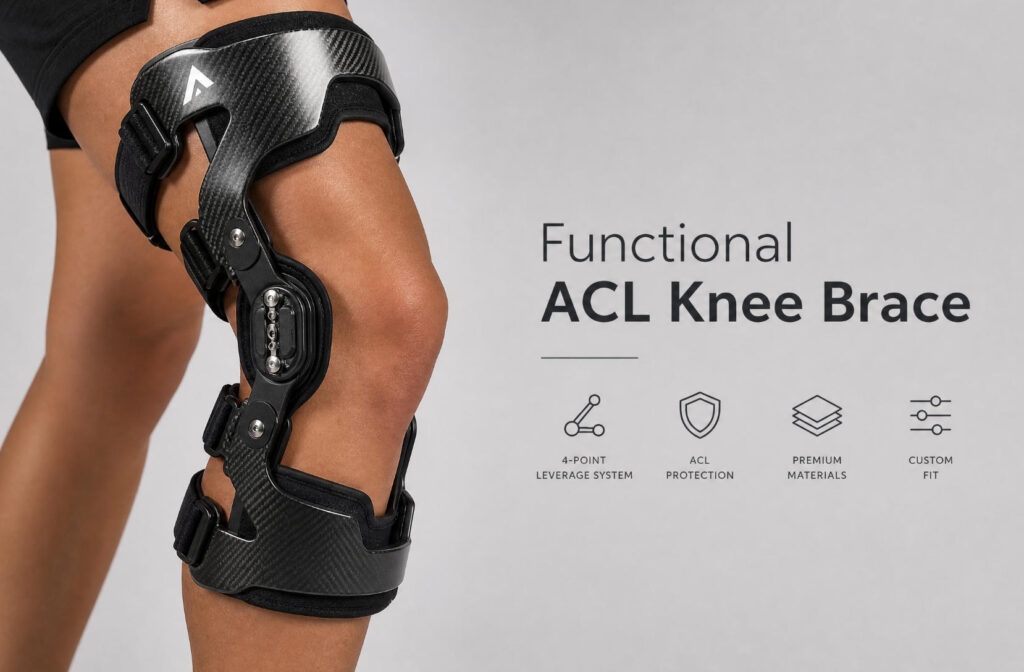
Functional ACL braces are designed to provide external support and assist knee stability during movement.
Their potential functions include:
1. Controlling Anterior Tibial Translation
One of the primary mechanical goals of an ACL brace is to help limit excessive forward movement of the tibia relative to the femur.
This may be particularly relevant for patients experiencing anterior knee instability.
2. Supporting Rotational Stability
ACL injuries often affect rotational control, especially during:
- Cutting movements
- Pivoting
- Sudden changes of direction
Some functional brace designs aim to provide additional resistance against rotational forces through:
- Rigid frame structures
- Adjustable hinge systems
- Three-point pressure principles
3. Improving Patient Confidence
Psychological readiness is an important part of ACL recovery.
Some patients experience fear of reinjury when returning to:
- Sports activities
- Work-related movements
- High-demand physical tasks
A functional brace may help improve confidence during progressive return-to-activity programs.
Evidence Considerations
It is important to recognize that the clinical evidence regarding routine ACL brace use remains mixed, particularly after ACL reconstruction.
Current clinical practice does not support the idea that every ACL patient requires a brace.
Brace selection should consider:
- Injury severity
- Surgical status
- Rehabilitation phase
- Patient activity requirements
- Clinician recommendations
Different brace designs, including rigid functional braces and soft sleeve-style supports, may provide different levels of mechanical support.
8. Frequently Asked Questions About ACL Injury Grades
What are the three grades of ACL injury?
ACL injuries are generally classified into three grades:
- Grade 1: Mild ACL sprain with stretched but intact ligament fibers.
- Grade 2: Partial ACL tear with some damaged fibers and reduced stability.
- Grade 3: Complete ACL rupture resulting in significant loss of ligament function.
Is a Grade 2 ACL tear serious?
Yes. A Grade 2 ACL injury is considered a moderate injury because part of the ligament structure is damaged.
However, severity does not depend only on the tear itself. Clinical outcomes are influenced by:
- Knee stability
- Patient activity level
- Rehabilitation quality
- Associated injuries
Some patients recover successfully with structured rehabilitation, while others may require surgical evaluation.
Do all ACL tears require surgery?
No.
Not every ACL tear requires reconstruction.
Treatment decisions depend on:
- Patient lifestyle
- Sports requirements
- Knee instability
- Associated injuries
- Personal treatment goals
Even some Grade 3 ACL injuries may be managed successfully without surgery in selected patients.
Can an ACL brace help with recovery?
A functional ACL brace may provide additional support during certain stages of rehabilitation.
Potential benefits include:
- Supporting knee stability
- Improving confidence during movement
- Assisting return-to-activity progression
However, braces should be used as part of a comprehensive rehabilitation program rather than as a replacement for muscle strengthening and neuromuscular training.
Conclusion
Understanding ACL injury grades helps healthcare professionals evaluate the severity of ligament damage and develop appropriate rehabilitation strategies.
From a mild Grade 1 ACL sprain to a complete Grade 3 ACL rupture, each injury presents different challenges regarding stability, recovery expectations, and treatment planning.
However, ACL management should go beyond the injury grade alone. A successful recovery plan requires consideration of:
- Patient activity demands
- Functional knee stability
- Associated injuries
- Rehabilitation goals
- Individual clinical circumstances
Functional ACL braces may provide valuable support for selected patients during rehabilitation and return-to-activity stages, particularly when additional stability and confidence are required.
At SAK BRACE, we focus on developing functional orthopedic bracing solutions designed to support healthcare professionals and patients throughout different stages of recovery.
Learn more about our orthopedic brace solutions:
www.sakbrace.com