

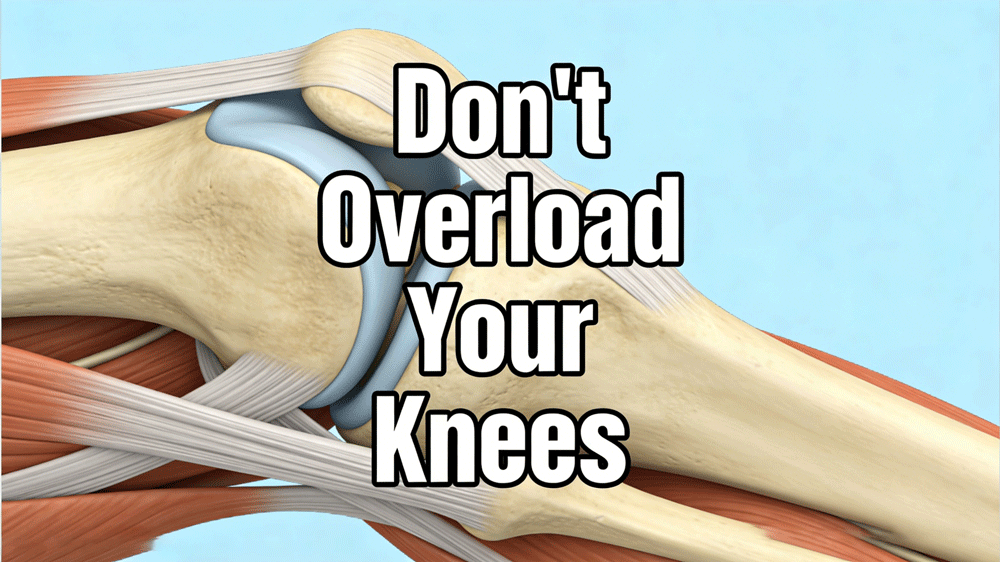
Don’t Overload Your Knees: Understanding the Most Common Knee Injuries Among Office Workers and Sports Enthusiasts
In orthopedic clinics or sports rehabilitation centers, knee discomfort is the second most common complaint after lower back pain. For office workers, knee problems seem like a “delayed punishment”—the strain accumulated on the sports field in their youth, or the muscle imbalances caused by long hours at the office, often begin to manifest after age 30. To maintain high-quality mobility throughout one’s career (whether commuting, business trips, or weekend sports and social activities), understanding the root causes of knee injuries is far more important than blindly taking calcium supplements or wearing knee braces. Below are the four most common objective causes of knee injuries, summarized based on clinical data: 1. Biomechanical Imbalance: The Overlooked Root Cause The knee joint itself is not the most flexible joint; its stability highly depends on the hip (gluteal muscles) above and the ankle below. Gluttonous Amnesia: Prolonged sitting can lead to gluteal muscle weakness. When the hips “go on strike,” the knee (especially the patella) bears extra torsional stress when walking or squatting, leading to patellar chondromalacia or iliotibial band friction syndrome. Foot biomechanics abnormalities: Flat feet or high arches alter the force line of the lower leg, causing uneven load distribution on the medial or lateral side of the knee joint, which can lead to meniscus wear in the long term. 2. Incorrect movement patterns: Not just “excessive intensity” Many injuries are not due to excessive exercise, but to incorrect movement patterns. Knee valgus: Unstable inward valgus of the knee during squats, lunges, or landings (common in women and those with weak core strength) is the leading cause of ACL ruptures and meniscus injuries. Locked joints: Overloading on leg extension machines or completely “locking” the knee joint while standing transmits pressure directly to the articular cartilage and ligaments. Comparison of incorrect and correct knee valgus posture 3. Sudden load changes: Violating the “10% rule” The knee joint adapts to pressure more slowly. Weekend Warrior Syndrome: Almost inactive during the weekdays, then suddenly engaging in high-intensity activities like soccer, basketball, or long-distance running on the weekend. Tendons and ligaments cannot quickly adapt to this drastic shift from “relaxation” to “impact,” easily leading to patellar tendinitis or acute sprains. Obesity and Rapid Weight Gain: For every kilogram of weight gain, the pressure on the knee joint during daily walking increases by 3-5 kilograms. Rapid weight gain is a significant early risk factor for knee osteoarthritis. 4. Structural Degeneration: Irreversible but Manageable Wear and Tear With age (usually after 35), the meniscus loses water and becomes more fragile; ligament elasticity decreases. Degenerative Changes: Often, meniscus injuries are not caused by a single violent impact, but by a tiny tear resulting from long-term wear and tear. This degeneration is irreversible once it occurs, but its progression can be slowed by strengthening the surrounding muscles. Conclusion: The knee joint is often not damaged by a single “accident,” but rather by the combined effects of prolonged sitting, incorrect squatting, and every extra pound of weight. If you’re reading this article and want to protect your knees throughout your long career, perhaps you can start today: stand up and break the sedentary lifestyle, learn to engage your glutes, and perform proper nerve activation before exercise. Have you ever experienced knee discomfort during exercise or in daily life? Feel free to share your experiences in the comments section, or tag a friend who needs to see this reminder. Frequently Asked Questions (FAQ) Q1: My knees click when I walk or go up and down stairs, but it doesn’t hurt. Should I be worried? A1: This condition is often called “physiological popping.” If it’s not accompanied by pain, locking, or swelling, there’s generally no need to worry excessively. This sound may originate from air bubbles bursting in the synovial fluid or friction from tendons sliding. However, if the sound is accompanied by pain, weakness, or a feeling that your knee is locked and cannot move, it could be a sign of a meniscus tear or chondromalacia patellae, and it’s recommended to see a doctor as soon as possible. Q2: Should I stop running and switch to swimming to protect my knees? A2: You don’t necessarily need to stop running. For people with healthy knees, moderate running can actually promote synovial fluid circulation and nourish cartilage. The key is “moderation” and “scientific approach.” You should pay attention to: Are your running shoes suitable? Is your running form correct? Are you running on hard surfaces for too long? Are you strengthening your quadriceps and glutes? If you already have knee problems, swimming (especially freestyle) and cycling are indeed good alternatives or cross-training methods because they can exercise your leg muscles without putting weight on them.