
Five years ago, what were the criteria for evaluating a smart knee brace or medical brace? Motor torque, battery life, and correction algorithms. But today, in 2026, as we stand at the intersection of rehabilitation engineering and smart wearables, the key factor determining whether users are willing to repurchase or wear the device long-term after their initial experience has returned to the most basic and fundamental indicator—breathability.
This is a very interesting industry turning point: “powerful functionality” is shifting from a “premium” to an “entry barrier,” while “unobtrusive wearing” is the new competitive advantage.
The Gap from “Functional Add-ons” to “Skin Extension”
For a long time, medical rehabilitation braces and exoskeletons have faced a huge paradox: users often buy them because of essential needs (such as post-operative rehabilitation and sports protection), but abandon them because they are “too uncomfortable.”
Traditional braces, in order to achieve support, typically use sealed plastic shells or composite gels, a design that is thermodynamically disastrous. Skin, as the body’s largest heat dissipation organ, becomes trapped in non-breathable materials for an hour, leading to sweat buildup, keratinization, and consequently skin inflammation, odor, and even bacterial infection. For chronically ill patients or elderly users who need to wear them for more than 8 hours a day, this “torture” experience directly results in a large number of devices being left idle.
In 2026, this pain point is being completely resolved by breakthroughs in materials science. The key to repurchase rates lies in the micron-scale structure of new materials.
Two Major Technological Paths in 2026: Active Temperature Regulation and Ultra-thin Breathability
At the beginning of this year, two research findings published in top international journals pointed the way for the industry.
1. The Era of “Active Ventilation” in Smart Textiles
A study published in Nature by Professor Tao Xiaoming’s team at Hong Kong Polytechnic University shows us the possibility of brace materials transitioning from “passive breathability” to “active temperature regulation.” The team developed a soft magnetorheological textile with a diameter of only 57 micrometers. It is not only lightweight and flexible, but more importantly, it achieves intelligent adjustment of breathability.
This means that future smart braces will no longer be static, dead-cavity structures. By driving the fiber structure to deform through an electrically controlled magnetic field, the brace can sense the skin’s microclimate: when it detects increased temperature or excessive humidity, the microstructure inside the material actively opens, achieving active ventilation. This “breathable” smart material elevates the temperature and humidity comfort of wearable braces to a new level, solving the fatal flaw of traditional braces being “stuffy.”
2. The “Ultra-Thin Revolution” in Interface Materials
If magnetorheological fibers solved the breathability problem of macroscopic structures, then the achievements of Professor Wang Yan’s team at the Guangdong Technion-Israel Institute of Technology, published in Science Advances, have solved the “invisibility” problem of the skin-electrode interface. The team developed a 2.7-micrometer-thick ultra-thin hydrogel electrode that is not only resistant to freezing and drying, but also possesses excellent breathability.
In wearable braces, the contact surface between the sensor and the skin is often a major area causing inflammation. When the thickness of the interface material is reduced to the sub-micron level, its bending stiffness is significantly reduced, allowing the electrodes to conform to the human body like skin, while allowing sweat to pass through, greatly reducing motion artifacts and skin allergies during long-term monitoring. When users can wear it continuously for 8 days without feeling its presence, repurchase becomes a natural choice.
Objective Data: The Economics Behind Breathability
Let’s look at some research data from Simon Fraser University in the field of prosthetic sockets: By using 3D-printed lattice structures (similar to honeycomb or trabecular bone), the new sockets improve energy absorption by 1600% when standing compared to solid structures. This porous lattice filling not only brings extreme lightweighting but also creates a huge heat dissipation surface area.
Behind this lies an objective fact: breathability is directly related to user compliance. Every 10% increase in compliance leads to an exponential change in the percentage reduction in rehabilitation time, the frequency of consumable replacements, and user trust in the brand. In a market with fierce competition for existing customers, if brace A keeps a user’s skin dry while brace B causes rashes, no matter how advanced B’s algorithm is, users will vote with their feet.
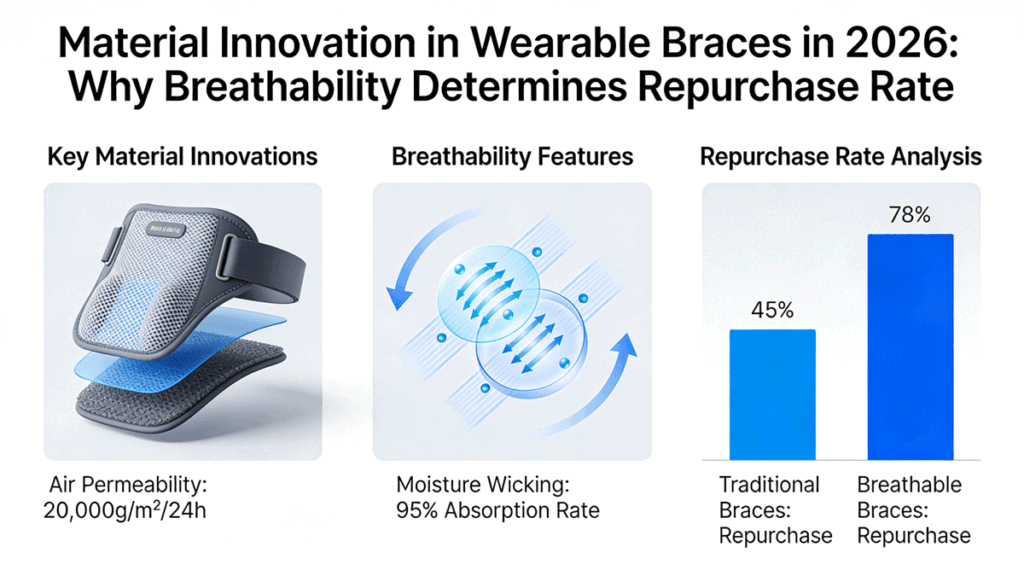
In conclusion, as practitioners deeply involved in this field, we must be keenly aware that consumers in 2026 will be sufficiently discerning in the consumer electronics market. They want the support of an exoskeleton, but also the comfort of a pure cotton T-shirt.
The industrialization approach of the Hong Kong Polytechnic University team is highly commendable—using commercial-grade raw materials and mature processing techniques to ensure rapid technology deployment. This reminds us that the revolution in breathability cannot remain confined to laboratory samples; it must be integrated into mass production lines at an affordable cost through engineering.
The leading players of the future will undoubtedly be those companies that make braces feel like a “second skin” rather than “mechanical armor.” Because only by respecting the skin can we win hearts; only by winning hearts can we win repeat purchases.
#Orthopedics #KneeBrace #MedicalDevices #Rehabilitation #HealthcareInnovation #MedicalDistributor